
Kai Schmidt · 14 September 2026
Eastern Europe's Universities Face Tensions Between Open Access Rules and Scholarly Independence
Universities across Eastern Europe continue to implement open access mandates that require researchers to make their work publicly available, yet these policies intersect with longstanding concerns about academic freedom in the region. Countries such as Hungary, the Czech Republic, Romania, and Slovakia have aligned their funding requirements with broader European Union frameworks, which tie grant eligibility to immediate deposition of articles in institutional repositories. Data from the European Open Science Cloud indicates that compliance rates in these nations reached 68 percent by the end of 2025, reflecting steady adoption of green open access routes through university servers.
Policy Landscape Across the Region
National research agencies in Eastern Europe have introduced specific rules that mirror elements of Plan S while adapting them to local funding structures. The Czech Science Foundation now requires all project outputs funded after 2023 to appear in compliant venues within six months of acceptance, and similar timelines apply in Slovakia through its national research agency. These measures aim to increase visibility of regional scholarship, and figures released by the European Commission show that Eastern European outputs in open access journals rose by 22 percent between 2021 and 2025. Institutions have responded by expanding repository infrastructure, with Hungary's national system processing over 14,000 deposits in the past year alone.
At the same time, universities must navigate legal frameworks that protect researchers' rights to select publication venues and retain control over their intellectual contributions. Academic freedom provisions embedded in national constitutions and university statutes emphasize autonomy in dissemination choices, creating an environment where administrators balance compliance targets against faculty expectations. Observers note that this balance becomes particularly visible in smaller institutions where library budgets limit options for covering article processing charges associated with gold open access models.
Implementation Challenges and Institutional Responses
Many Eastern European universities have established dedicated open science offices to support compliance without restricting researcher options. These offices provide guidance on repository deposits, negotiate read-and-publish agreements with major publishers, and track policy updates that will take effect in September 2026 under revised Horizon Europe guidelines. The agreements allow affiliated authors to publish without direct fees in hybrid journals, and early data from the Czech Technical University suggests that such deals have reduced out-of-pocket costs for participating departments by approximately 35 percent since introduction.
Researchers in the humanities and social sciences often encounter different pressures than those in the natural sciences, since journal ecosystems in these fields rely more heavily on subscription models that have not yet transitioned to open access at the same pace. Studies compiled by the European University Association reveal that Eastern European humanities scholars publish roughly 40 percent of their work in national-language journals, many of which lack immediate open access pathways. Institutions have therefore developed local language repositories that permit delayed open access while preserving the option for traditional publication routes.
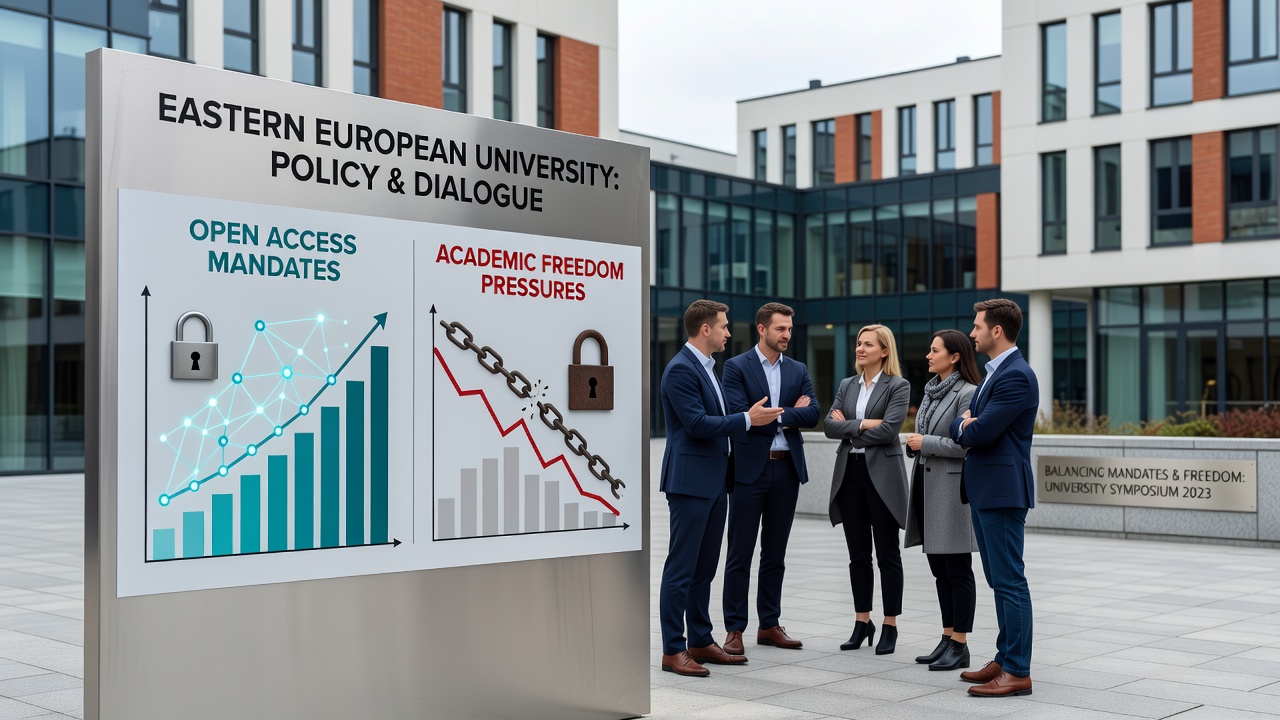
Academic Freedom Considerations
Concerns about academic freedom surface most clearly when mandates appear to limit choices regarding where and how research appears. Faculty senates in several Romanian universities passed resolutions in 2024 affirming that open access requirements should not override individual decisions on journal selection or embargo periods. These statements reference broader European declarations on academic freedom and emphasize that compliance mechanisms must remain flexible enough to accommodate disciplinary differences. University leadership has generally incorporated such feedback into policy documents, adding clauses that allow exemptions for specific publication formats or when copyright transfer agreements conflict with funder terms.
Training programs have emerged as a practical response to these tensions. Workshops organized by national rectors' conferences cover topics such as rights retention strategies, which enable authors to deposit preprints or accepted manuscripts while retaining copyright. Participants learn how to use addenda that modify standard publisher contracts, and attendance records indicate strong interest from early-career researchers who anticipate future grant applications. These sessions also address how open access practices intersect with national evaluation systems that still weight journal impact factors heavily in promotion decisions.
Looking Ahead to September 2026
Upcoming policy adjustments scheduled for September 2026 will introduce tighter timelines for deposit and new monitoring requirements tied to EU research funding cycles. Eastern European ministries of education have begun consultations with university representatives to prepare implementation roadmaps that maintain both compliance and institutional autonomy. Preliminary drafts circulated among rectors' conferences propose expanded support for diamond open access journals, which operate without author fees or reader subscriptions, as one mechanism to ease financial pressures while broadening access.
Cross-border collaborations have also gained traction, with joint repository networks linking institutions in Poland, Hungary, and the Baltic states to share technical infrastructure and reduce duplication of effort. These networks allow researchers to deposit once and satisfy multiple national mandates, and early participants report simplified workflows that free time for core research activities. The approach aligns with recommendations from international bodies focused on research infrastructure and reflects ongoing efforts to integrate Eastern European scholarship into global open science ecosystems.
Conclusion
Eastern European universities continue to refine their approaches to open access mandates while preserving space for academic independence. Through expanded repositories, negotiated publishing agreements, targeted training, and forthcoming policy adjustments in September 2026, institutions demonstrate concrete steps that address both access goals and faculty concerns. Data collected over the coming years will clarify how these measures perform across disciplines and funding contexts, providing further evidence for adjustments that keep regional research visible and researchers autonomous.